Charts made easy. The fastest way to create beautiful charts and graphs for your projects.
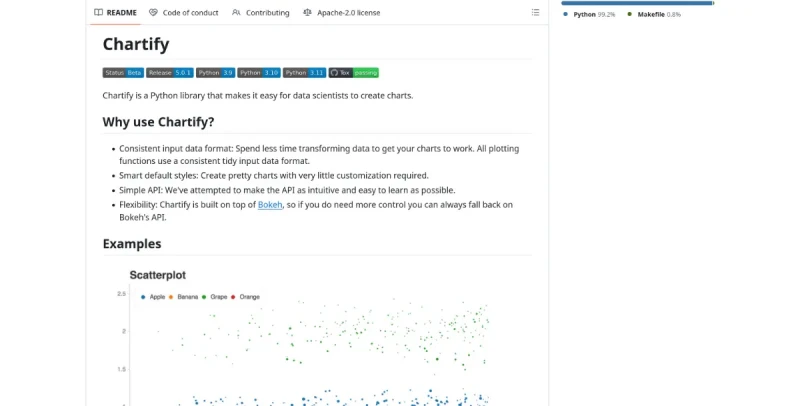
Chartify is a Python library specifically designed to make it easy for data scientists to create charts.
Here is a summary of its main features and functionalities:
Core Library Functionalities (Chartify)
Chart Creation for Data Scientists: Chartify is a Python library that makes it easy for data scientists to create charts.
Simple and Intuitive API: The project prioritizes ease of use, having a simple API that is intuitive and easy to learn.
Consistent Data Input: All plotting functions utilize a consistent tidy input data format, which reduces the time spent transforming data.
Smart Default Styles: Users can create pretty charts with very little customization required due to the built-in smart default styles.
Underlying Technology and Flexibility: Chartify is built on top of Bokeh. This provides flexibility, allowing users to fall back on Bokeh's API if they need more control.
Installation: It can be installed via
pip(pip3 install chartify).PNG Output Requirement (Optional): For users who require PNG output, an additional dependency, chromedriver, must be installed and configured in their system PATH.
Support and Licensing: The project adheres to the Apache-2.0 license and offers support via the
chartifytag on StackOverflow.
GitHub Platform Features (Context)
As Chartify is hosted on GitHub, it utilizes the platform's developer environment features:
AI and Code Tools: Features like GitHub Copilot (to write better code with AI), GitHub Spark (to build and deploy intelligent apps), and GitHub Models (to manage and compare prompts) are available.
Development Workflow: Developers can use Actions (to automate workflows), Codespaces (for instant dev environments), Issues (to plan and track work), and Code Review (to manage code changes).
Security: GitHub Advanced Security helps users find and fix vulnerabilities.
Search and Exploration: Users can search code, repositories, users, issues, and pull requests, and utilize saved searches to filter results more quickly.
You may also be interested in ...

Shoelace

Splitting