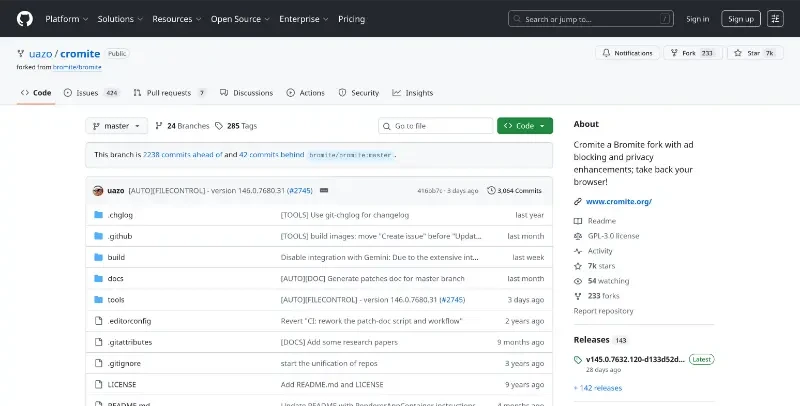
Cromite is a Chromium fork based on Bromite with built-in support for ad blocking and an eye for privacy.
Cromite is an open-source Chromium fork based on the Bromite project, specifically designed to provide built-in ad blocking and enhanced privacy features. Its primary goal is to allow users to "take back" their browser by limiting the data collection and tracking typically integrated into standard browsers.
Here is a summary of its principal functionalities:
Privacy and Anti-Tracking Enhancements
Built-in Ad Blocking: Cromite natively blocks advertisements without the need for additional extensions.
Feature Limitation: It aims to limit or disable browser features that track user habits; where disabling is not technically possible, it leaves the choice to the user to re-enable them.
Anti-Fingerprinting: The browser includes mitigations to prevent website fingerprinting, though it is not intended to be a comprehensive anonymity tool like the Tor Browser.
Manufacturer De-integration: It works to reduce the close integration between the browser software and its manufacturer.
Security and Advanced Configuration
Security Patches: Cromite integrates security enhancements from multiple privacy-focused projects, including GrapheneOS, Brave, and ungoogled-chromium.
Sandboxing: On Windows, it supports advanced security features such as the network process sandbox and the AppContainer for renderer processes.
Linux Security Integration: For Linux users (specifically Ubuntu 24.04), it provides instructions for creating AppArmor profiles to manage unprivileged user namespaces.
Cross-Platform Availability
Wide Device Support: It is available for Android (v10+), Windows (64-bit), and Linux (64-bit).
Android Architectures: On Android, it supports several architectures, including arm64-v8a, arm32-v7a, and x86_64.
WebView Support: In addition to the standalone browser, the project provides Cromite System WebView APKs for Android.
Distribution and Updates
Auto-Update Functionality: Android users can receive and install updates automatically via an integrated auto-updater.
F-droid Integration: The project maintains an official F-droid repository for secure and easy installation on Android.
Open Source: It is published under the GNU GPL v3 license, ensuring transparency and allowing for community contributions.
You may also be interested in ...

Helium

Waterfox

Floorp