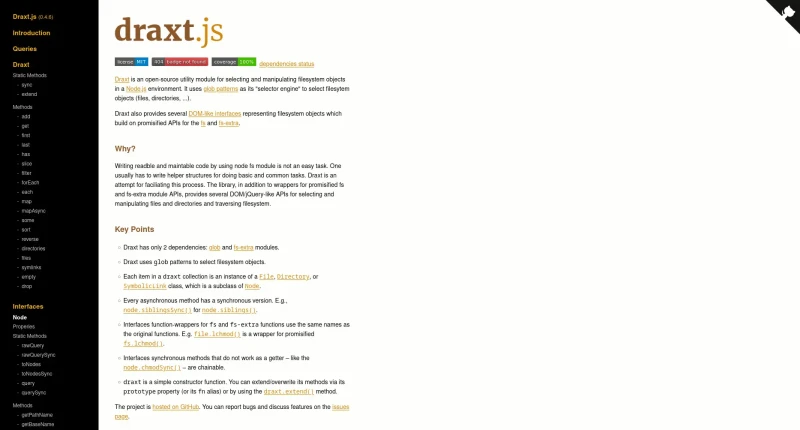
Draxt is an open-source utility module for selecting and manipulating filesystem objects in a Node.js environment. It uses glob patterns as its "selector engine" to select filesytem objects (files, directories, ...).
Draxt.js (version 0.4.6) is an open-source utility module for selecting and manipulating filesystem objects in a Node.js environment. It provides DOM-like and jQuery-like interfaces to simplify the process of navigating, reading, and modifying files and directories.
The main features of this library include:
jQuery-Like Glob Selector Engine: The main
draxtconstructor function works as a factory that accepts a standard glob pattern (e.g.,'/app/**') to query the filesystem. It translates matching paths into a collection of node instances wrapped in adraxtcollection.DOM-Like Node Hierarchy: Every item matched by a query is analyzed and converted into a specific class instance depending on its type. These classes include
File,Directory, andSymbolicLink, all of which inherit from a commonNodebase class.Dual Sync and Async Capabilities: To accommodate different application architectures, every asynchronous method in Draxt has a corresponding synchronous counterpart (such as
node.siblings()andnode.siblingsSync()).Method Chaining for Sync Operations: Synchronous methods that do not serve as getters (for example,
node.chmodSync(),node.appendToSync(), orfile.ensureSync()) are chainable, allowing you to perform complex pipeline modifications on a single line of code.Array and Collection Traversal Utilities: The
draxtcollection provides standard array-like helper methods includingfilter(),forEach()(or its aliaseach()),map(),mapAsync(),some(),sort(),reverse(), andslice()to manage files in bulk. You can also instantly filter collections using specialized helper methods likedirectories(),files(), andsymlinks().Powerful Directory-Specific API:
Directoryinstances come with specialized tools for directory manipulation, such as recursively locating descendants (find()), listing direct contents (children()), checking if a directory is vacant (isEmpty()), and automatically creating or emptying directories without deleting the root folder itself (ensure()andempty()).Rich File and Link Operations:
Fileinstances provide promisified wrappers for standard operations likeread(),write(),append(), andtruncate(). Similarly,SymbolicLinkinstances feature helper methods likeisBroken()to easily detect dead symlinks.Minimal Dependencies & High Extensibility: The library is built with only two core dependencies:
globandfs-extra. Developers can easily extend or overwrite its core functionality using theprototypeproperty (or itsfnalias) or by calling the staticdraxt.extend()method.
You may also be interested in ...

Payload CMS

Beluga