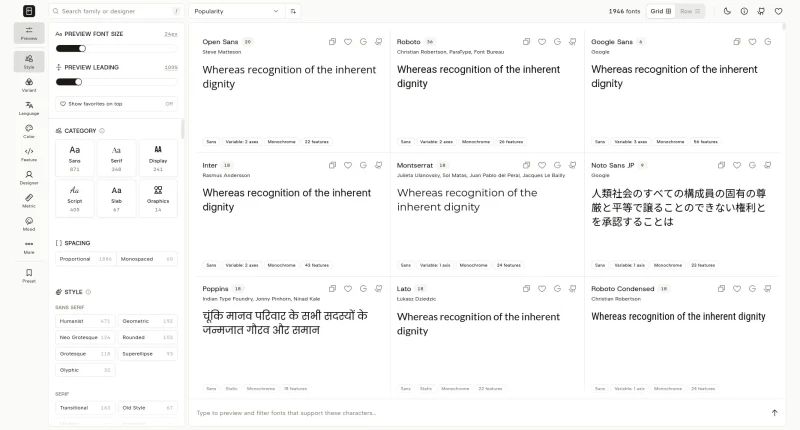
FontFridge allows you to dig through the massive Google Fonts archive using very powerful filters.
FontFridge (formerly FontColle) is an open-source, highly granular search and filtering directory for the Google Fonts library, hosted at https://font.chingru.com/. It is designed specifically to help designers, developers, and font engineering enthusiasts discover the exact typefaces they need by filtering for deep typographic attributes that standard font directories do not expose.
The main features of this tool include:
Advanced Variable Font Axis Filtering: While standard libraries only let you filter by "variable font" as a broad category, FontFridge allows you to narrow down your search by specific variable axes, such as weight (
wght), width (wdth), and optical size (opsz).Deep OpenType Feature Search: You can search for fonts that support specific OpenType layout features, such as stylistic sets (
ss##), historical ligatures (hlig), and other advanced ligatures or glyph substitutions.Exact Character & Language Support: You can paste any custom text, uncommon characters, or glyphs into the search to immediately filter down to the exact font families that fully support every single character you entered—making it incredibly simple to verify language coverage.
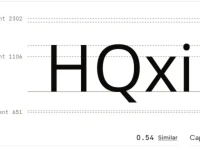
Granular Metrics & Design Specifications: It supports filtering by subtle technical specs, including x-height, cap-height ratio, UPM (Units Per Em), hinting, and color font formats.
Rich, Interactive Font Previews: Each font family page offers editable specimen text, live previews of all named instances, designer biographies, and an interactive glyph browser organized neatly by Unicode blocks.
Multiple CDN Embedding Options: To make development faster, the tool provides ready-to-use embed codes not just for Google Fonts, but also for Bunny Fonts and Fontsource.
Completely Open Source: Every font family maintains its original open-source license, and the directory tool itself is MIT-licensed, with its source code publicly available on GitHub.
You may also be interested in ...

Bestaticpy

VideoJS