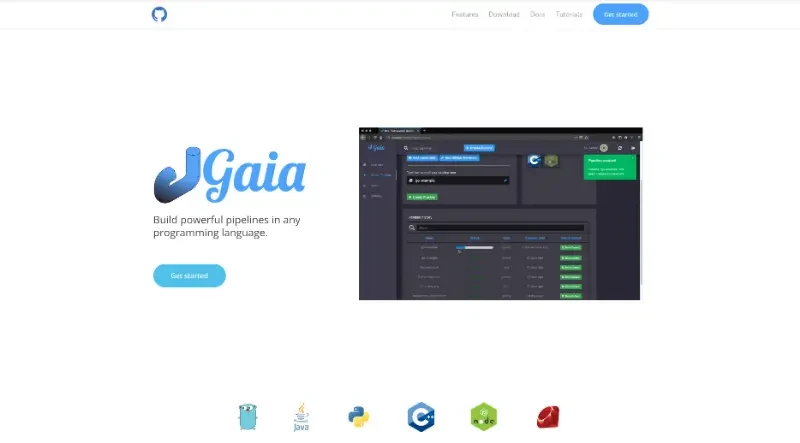
Build powerful pipelines in any programming language. Gaia is the next evolution of automation platforms whose goal is to provide full flexibility and performance for today's CI/CD, but basically any automation workflow imaginable.
Gaia is an open-source automation platform designed to handle CI/CD and any imaginable automation workflow with maximum flexibility. Its core philosophy is to be developer-first, moving away from complex configuration files in favor of standard programming languages.
The main features of this tool include:
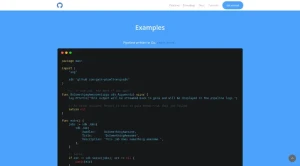
Programming Language Independence: Gaia allows you to write automation pipelines in any programming language. It currently officially supports Go, Java, Python, C++, Ruby, and Node.js, eliminating the need for endless lines of YAML or JSON configuration.
High Performance and Efficiency: The core of Gaia is written in Go, and it uses gRPC over HTTP/2 for pipeline communication, making it ultra-lightweight and "super fast".
Automatic Build Pipeline: Gaia features automatic builds; once you push code to a Git repository, the platform clones the repo, compiles the code into a binary, and executes it on demand. It automatically detects changes and rebuilds pipelines in seconds.
First-Class Testing Support: You can write unit tests for your automation pipelines exactly as you would for your applications, ensuring high reliability in your DevOps processes.
Simple Deployment: Gaia is distributed as a single self-contained binary that can be started without any configuration. It also provides Docker images and Helm charts for those who prefer running tools in Kubernetes.
Unix Philosophy: The tool is built on principles of being simple, modular, and composable, making it an "automation platform of the future" that simplifies the management of complex IT applications.
Open-Source Transparency: It is a community-driven project where the source code is open for review, discussion, and contribution.
You may also be interested in ...

:where() :is() :has()? New CSS selectors that make your life easier

Tonic