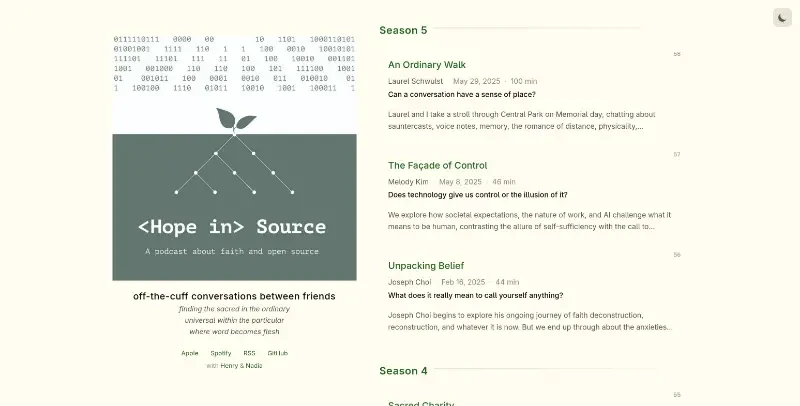
What are the parallels between faith and open source software? Join Nadia Eghbal and Henry Zhu for an off-the-cuff conversation between friends.
Hope in Source is an insightful podcast hosted by Henry and Nadia that explores the deep, often unexpected resonances between open-source software and faith. Through "off-the-cuff conversations," the show seeks to find the "sacred in the ordinary" and explore how technology and belief systems shape the human experience.
The main themes of this podcast include:
The Intersection of Faith and Open Source
Gift Economy vs. Market Economy: The podcast explores open source as a gift economy rather than a market one, drawing parallels to the biblical "Dorean Principle" where the Gospel (or code) is freely given.
Secular Liturgies: Guests discuss how rituals, habits, and community traditions (like "Taco Tuesday") act as forms of secular liturgy that shape belief systems in tech and religion.
Evangelism and Motivation: The show examines the motivations for contributing to open source, comparing them to intrinsic religious motivations, tithing, and the "prosperity gospel".
Critique of Technology and Control
The Illusion of Control: Episodes challenge whether technology provides true control or merely the façade of control, especially in the context of AI and societal expectations.
Digital Disembodiment: The hosts discuss how digital environments can lead to disembodiment, moving users away from physical space, texture, and natural affordances.
Ivan Illich’s Philosophy: The podcast frequently draws on the work of Ivan Illich to critique institutional monopolies, the tyranny of updates, and the need for "convivial tools" that promote autonomy.
Community, Maintenance, and Burnout
Sustainable Maintenance: Discussions often focus on the "aesthetic of maintenance" and the responsibility of taking care of the digital and physical spaces we inhabit.
Hope Amidst Burnout: The show explores finding hope during times of weariness, contrasting the "arms race of escalation" in tech with the need for rest and waiting.
Digital Death and Archival: Guests reflect on software preservation, the importance of maintaining history in a future-obsessed industry, and the decision to "unlist" oneself from the public internet.
Embodiment and Reality
Reality as Interpersonal: A recurring theme is that reality is personal and interpersonal, emphasizing gift economies, belonging, and "knowing through doing".
Holy Inefficiency: The podcast advocates for "holy inefficiency"—doing things for their own sake rather than purely for productivity or measurable output.
Sense of Place: Conversations emphasize physicality and the "romance of distance," often using specific locations like Central Park or New York City to ground abstract technological values.

You may also be interested in ...

Maximally optimizing image loading for the web in 2021

Phaser