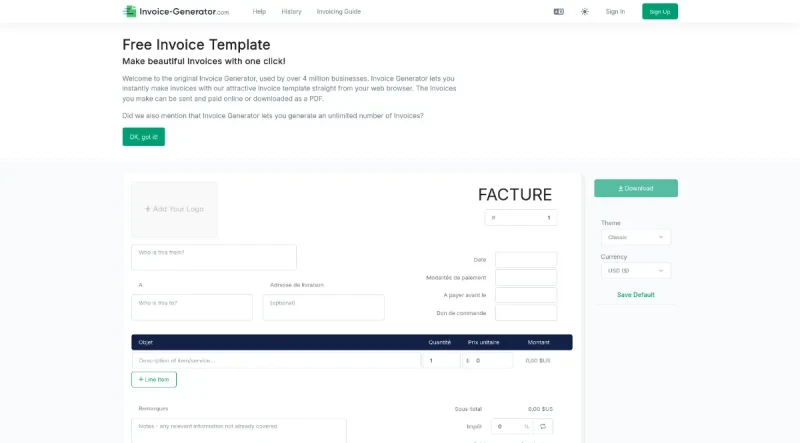
Invoice Generator, generate your invoice online or via an API.
1. Invoice-Generator.com (Online Tool & API)
This tool functions as a simple, free online invoice maker that allows users to quickly generate professional-looking invoices, primarily aimed at freelancers and small business owners.
Ease of Use: It is highly praised for its user-friendliness, speed, and straightforward interface, allowing for quick creation and download.
Output Formats: Generates invoices as PDFs.
E-Invoicing Support (API): Offers an API (Invoice Generator API) that can generate e-invoices in UBL (Universal Business Language), a format necessary for digital compliance, with the PDF embedded.
Customization: Supports adding logos, specifying VAT/Tax details, using custom fields (e.g., purchase order or account number), and adjusting localization (e.g., French, German, Spanish).
Data Privacy: The service explicitly states that it does not store user invoice data. However, the web tool can remember the user's last invoice details without requiring a login.
API Usage: The API provides endpoints for both PDF and UBL e-invoice creation, accepting inputs via cURL or JSON. The free API plan has a limit of 100 invoices per month.
2. Comparison of Invoicing Tools (Generator vs. Software)
The sources distinguish between simple generators and full invoicing software:
Tool CategoryKey Functionalities (Pros)Key Limitations (Cons)Invoice GeneratorTypically free. Easy to use; what you see is what you get. Offers short-term speed.Does not save invoices, requiring users to manually store them. No automatic tracking of due dates or overdue payments. No easy way to accept payments (requires third-party gateways). Cannot automatically generate credit notes.Invoice SoftwareCreates professional invoices. Saves client, product, and company details for quick reuse. Safely stores all invoices for auditing and bookkeeping. Automatically tracks and flags overdue invoices. Can automatically generate credit notes.Can be a costly investment, though many free options (like Conta) exist.
3. French E-Invoicing (Facturation Électronique) Framework
This mandatory governmental system is being introduced in France to replace traditional paper and standard PDF B2B invoices, aiming to simplify tax obligations and reduce fraud.
Mandatory Compliance: Applies to all VAT-registered businesses in France.
Deadlines: All businesses must be able to receive electronic invoices by September 1, 2026. Emission deadlines vary by company size: large/medium enterprises must issue by September 1, 2026, while small/micro-enterprises must issue by September 1, 2027.
Required Formats: Invoices must use specific structured digital formats like Factur-X (XML/PDF hybrid), UBL (Universal Business Language), or CII (Cross Industry Invoice).
Transmission Channel: Mandatory exchange must occur via certified Partner Dematerialization Platforms (PDPs). The Public Invoicing Portal (PPF) serves as a central directory and data hub, not a primary exchange platform.
E-Reporting: Requires electronic transmission of key transaction data (not the full invoice) to tax authorities for non-B2B transactions, such as B2C sales and cross-border/international transactions (exports/imports).
Invoice Lifecycle Management: The system requires real-time, mandatory tracking of the invoice lifecycle, including automated status updates (e.g., Submitted, Rejected, Paid).
Sanctions: Failure to issue or transmit e-invoices or e-reporting data can result in significant penalties (e.g., €15 per non-compliant invoice, up to €15,000 annually per business).
4. Other Software Mentions
Momenteo: A free online invoicing and quoting software tailored for freelancers (travailleurs autonomes). Its features include creating and personalizing quotes/invoices, tracking their status, managing clients and expenses, and using an intuitive calendar to track work, mileage, and expenses for simplified bookkeeping.
Wave, Zoho Invoice, Square, Bookipi, Paymo: These are full-featured free invoicing software solutions recommended for various business needs, offering features like recurring billing, detailed reporting, client management (mini-CRM in Zoho), time-tracking integration (Paymo), and seamless connection to payment processors.
You may also be interested in ...
Deploying CSS Logical Properties On Web Apps
BarbaJS