

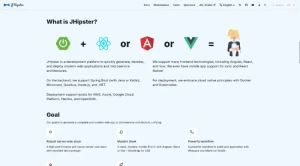
JHipster is a development platform to generate, develop and deploy Spring Boot + Angular/React Web applications and Spring microservices.
JHipster is an open-source development platform used to quickly generate, develop, and deploy modern web applications and complex microservice architectures,. It aims to provide a complete development environment by unifying a high-performance server-side stack with a modern user interface.
The main features of this platform include:
Full-Stack Code Generation: JHipster generates a complete and modern web application from scratch, unifying a robust backend with a mobile-first frontend.
Diverse Frontend Support: The platform supports leading frontend technologies, including Angular, React, and Vue. It also provides support for mobile app development through Ionic and React Native.
Flexible Backend Options: On the server side, JHipster supports Spring Boot (with Java or Kotlin), Micronaut, Quarkus, Node.js, and .NET. These stacks are designed for high performance and include excellent test coverage.
Cloud-Native Deployment: It embraces cloud-native principles by using Docker and Kubernetes. It provides "infrastructure as code" to allow for rapid deployment to various cloud providers, including AWS, Azure, Google Cloud Platform, Heroku, and OpenShift,.
Powerful Build Workflow: The platform utilizes professional development workflows, integrating tools like Webpack for the frontend and Maven or Gradle for the backend.
Extensible Ecosystem: JHipster features a wide array of modules and blueprints, allowing developers to extend the platform's functionality and customize the generated code to specific needs.
Continuous Integration/Deployment (CI/CD): The platform includes built-in options to manage CI/CD pipelines, ensuring that applications can be tested and deployed automatically.

You may also be interested in ...

Single-spa

Interneting is hard