

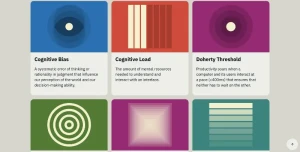

A collection of nineteen key maxims that designers must consider when building user interfaces
Laws of UX is a comprehensive collection of best practices and psychological principles that designers can use as a guide when building user interfaces. It translates complex cognitive psychology into actionable design rules to create more intuitive and human-centered digital experiences.
The main features (principles) of this resource include:
Cognitive Efficiency and Decision Making: It highlights laws such as Hick’s Law, which states that the time to make a decision increases with the number of choices, and Miller’s Law, which notes the average person can only keep about seven items in their working memory.
Visual Organization (Gestalt Principles): The collection includes rules like the Laws of Proximity, Similarity, and Common Region, which explain how users naturally perceive elements as groups based on their physical relationship or shared boundaries.
Predictability and Familiarity: Central to this is Jakob’s Law, which suggests that because users spend most of their time on other sites, they prefer your site to work in the same way as the ones they already know.
Time and Performance: It emphasizes the Doherty Threshold, asserting that productivity soars when system response times are under 400ms, and Fitts’s Law, which relates the time to acquire a target to its distance and size.
Memory and Perception: The resource covers how we remember experiences, such as the Peak-End Rule (judging an experience by its peak and end) and the Serial Position Effect (remembering the first and last items in a series best).
Managing Complexity: It addresses the balance of complexity through Tesler’s Law (complexity cannot be reduced beyond a certain point) and Occam’s Razor (the simplest solution is usually the best).
User Behavior Tendencies: It identifies patterns like the Paradox of the Active User, where users skip manuals to start using software immediately, and the Zeigarnik Effect, where uncompleted tasks are remembered better than completed ones.

You may also be interested in ...
Waveform Renderer

Primo