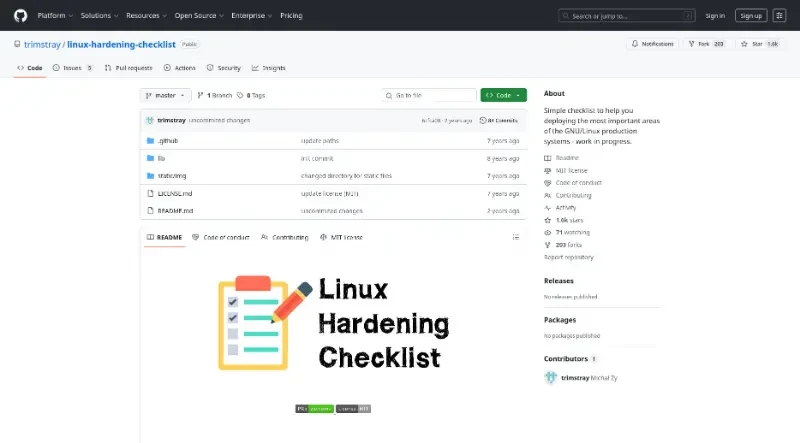
This simple checklist is to help you deploying the most important areas of the GNU/Linux production systems. Thanks to Trimstray.
The Linux Hardening Checklist is an open-source resource designed to help administrators secure GNU/Linux production systems by reducing their attack surface and eliminating potential vulnerability vectors.
The main features and functionalities of this guide include:
1. Categorized Security Rules
The tool organizes hardening tasks into critical system areas to ensure a comprehensive security posture:
Partitioning & Storage: Instructions for using separate partitions (e.g.,
/boot,/home,/var/log) and restricting mount options such asnodev,nosuid, andnoexec.Kernel Hardening: Methods to restrict access to kernel logs and pointers, enable ExecShield, and implement memory space randomization.
User & Access Management: Guidelines for enforcing strong PAM password policies, setting auto-logout for inactive users, and locking accounts after failed login attempts.
Network Security: Rules for enabling TCP SYN Cookie protection and disabling dangerous protocols like IP source routing and ICMP redirects.
System Integrity: Protections for bootloader configuration files and the enforcement of SELinux in "Enforcing" mode.
2. Priority-Based Implementation
To help administrators manage their workflow, the checklist uses a three-level priority system:
Low (*): Important but non-critical items.
Medium ():** Significant items that should not be avoided.
High ():* Mandatory rules that must be followed and implemented to ensure basic security.
3. Technical Documentation & Examples
Actionable Commands: Every rule includes specific command-line examples or configuration file edits (e.g.,
sysctlconfigurations orfstabentries) to facilitate direct implementation.OpenSCAP Compatibility: The list is designed to be compatible with the Security Content Automation Protocol (SCAP) standard, allowing it to work alongside automated auditing tools like OpenSCAP or Nessus.
Progress Tracking: Each section concludes with a summary checklist (checkboxes) so users can visually track their deployment status across the system.

You may also be interested in ...

How To Secure A Linux Server

SVG Loaders