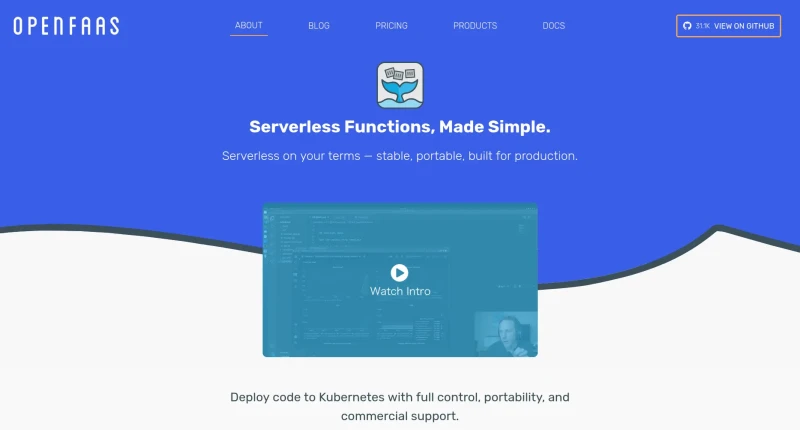
Serverless Functions, Made Simple. OpenFaaS makes it simple to turn anything into a serverless function that runs on Linux or Windows through Docker Swarm or Kubernetes.
OpenFaaS (Open Function as a Service) is a production-ready serverless framework designed to make deploying functions and microservices to any Kubernetes cluster simple, portable, and manageable. Founded by Alex Ellis, it allows developers to run event-driven workloads across on-premises and multi-cloud environments.
The main features of this platform include:
Kubernetes-Native & Portable: Functions are deployed as portable Open Container Initiative (OCI) images on any Kubernetes cluster, providing a consistent experience across on-premises infrastructure and public clouds without vendor lock-in.
Language & Framework Agnostic: Supports official templates for Node.js, Python, Go, Java, C#, Ruby, PHP, Bash, and custom Dockerfiles. Existing microservices built with frameworks like Express.js, Flask, FastAPI, Django, or ASP.NET Core can also be deployed as-is.
Efficient Auto-Scaling (Including Scale-to-Zero): Functions automatically scale to meet incoming demand and can be fine-tuned to scale down to zero when idle to minimize infrastructure costs.
Event-Driven Workloads: Invokes functions automatically from a wide range of event sources, including Apache Kafka, AWS SQS/SNS, GCP Pub/Sub, RabbitMQ, PostgreSQL, Cron schedules, and MQTT.
Out-of-the-Box Queuing & Async Retries: Simplifies ETL, batch jobs, and machine learning data pipelines by providing built-in asynchronous queuing, retries, and parallel execution for jobs lasting from milliseconds to hours.
Customer Code Sandboxing: Enables SaaS applications to safely execute untrusted customer code by converting code snippets into isolated functions deployed via a REST API, with security boundaries enforced in dedicated Kubernetes namespaces.
OpenFaaS Pro Enterprise Features: Adds advanced capability modules including SSO (Single Sign-On), RBAC (Role-Based Access Control), monitoring dashboards, queue-based autoscaling, and direct-to-engineering support.
Developer CLI (
faas-cli): Features a command-line interface to pull language templates from the template store, create new functions, and build or deploy workloads easily.
You may also be interested in ...

VueJS the documentary
Frontend checklist