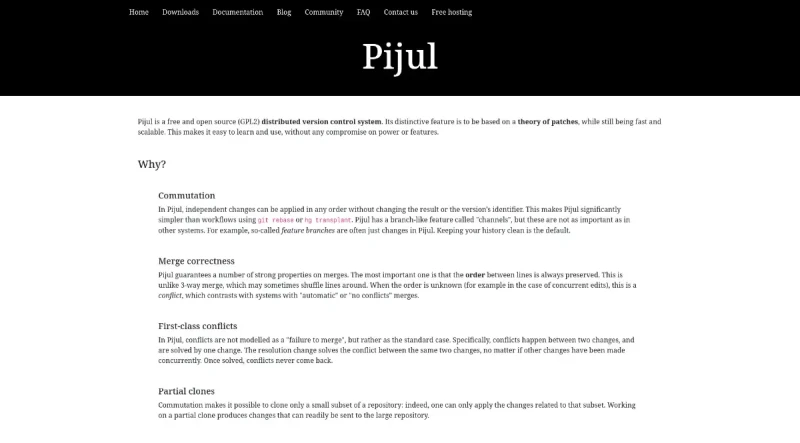
Pijul, a free and open source (GPL2) distributed version control system by Pierre-Étienne Meunier and Florent Becker
Pijul is a distributed version control system (DVCS).
Here is a summary of its main features and functionalities:
Core Identity and Philosophy
Version Control System (DVCS): Pijul is a free and open source (GPL2) distributed version control system.
Patch Theory Basis: Its distinctive feature is that it is based on a theory of patches.
Speed and Scalability: It is designed to be fast and scalable.
Bootstrapped: Pijul is bootstrapped, meaning it is used for its own development.
Unique Approach to Changes and History
Commutation (Order Independence): This is a key feature where independent changes can be applied in any order without changing the result or the version's identifier.
This property makes Pijul significantly simpler than workflows that rely on complex commands like
git rebaseorhg transplant.Keeping your history clean is the default.
Channels (Feature Branches): Pijul has a branch-like feature called "channels," but these are not as important as branches in other systems. Often, so-called feature branches are simply treated as changes in Pijul.
Merging and Conflict Handling
Guaranteed Merge Correctness: Pijul guarantees strong properties on merges.
The most important guarantee is that the order between lines is always preserved. This contrasts with 3-way merge systems, which may shuffle lines around.
First-Class Conflicts: Conflicts are treated as the standard case, not as a "failure to merge".
When the line order is unknown (due to concurrent edits), it is defined as a conflict.
A conflict happens between two changes and is solved by one change.
The resolution change solves the conflict between the same two changes, regardless of concurrent changes.
Once a conflict is solved, it never comes back.
Usability and Scalability Features
Partial Clones: The commutation property makes it possible to clone only a small subset of a repository.
This works because one only needs to apply the changes related to that specific subset.
Changes produced while working on a partial clone can be readily sent to the large repository.
Ease of Use: Pijul is designed to be easy to learn and use, without compromising on power or features.
You may also be interested in ...
Delegated Events
DropCSS