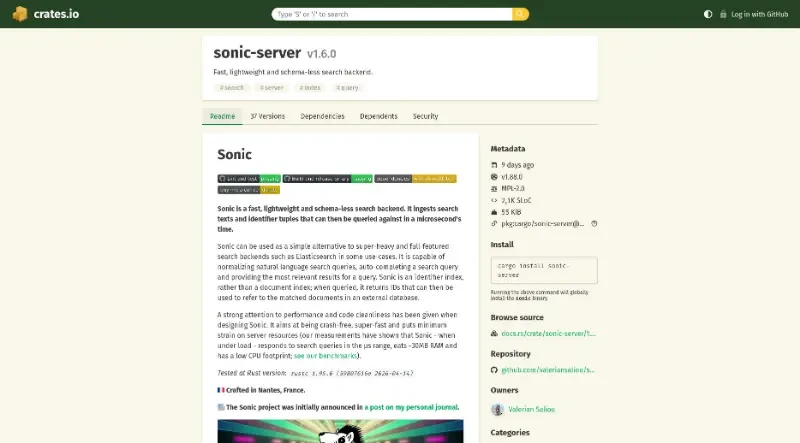
Sonic is a fast, lightweight and schema-less search backend. It ingests search texts and identifier tuples that can then be queried against in a microsecond's time.
Sonic is a fast, lightweight, and schema-less search backend written in Rust, designed as a high-performance alternative to "heavyweight" systems like Elasticsearch for specific use cases.
The main features of this tool include:
Ultra-Fast Performance: It is engineered for speed, responding to search queries in the microsecond (µs) range.
Minimal Resource Footprint: Sonic is extremely efficient, typically consuming only about 30MB of RAM and maintaining a low CPU footprint even under heavy load.
Identifier Index Model: Unlike traditional document indexes, Sonic is an identifier index; it returns IDs that you then use to retrieve the full documents from your own external database.
Advanced Search Functionality: It supports auto-completion (suggestions), typo correction (fuzzy search), and natural language normalization to provide relevant results even with user errors.
Global Language Support: The system offers full Unicode compatibility for over 80 of the most spoken languages, including automatic language detection and stop-word removal.
Lightweight Network Protocol: It communicates via the Sonic Channel, a simple TCP-based protocol designed to be much lighter and faster than traditional HTTP APIs.
Flexible Organization: Search terms are organized into collections and buckets, allowing you to isolate indexes (for example, having a separate bucket for every user on your platform).
Real-Time Indexing: Data ingestion (adding or removing items) is light and can be done while the server is running, with background tasks quickly making the new data searchable.

You may also be interested in ...

Target="_blank" - the most underestimated vulnerability ever

Glidejs