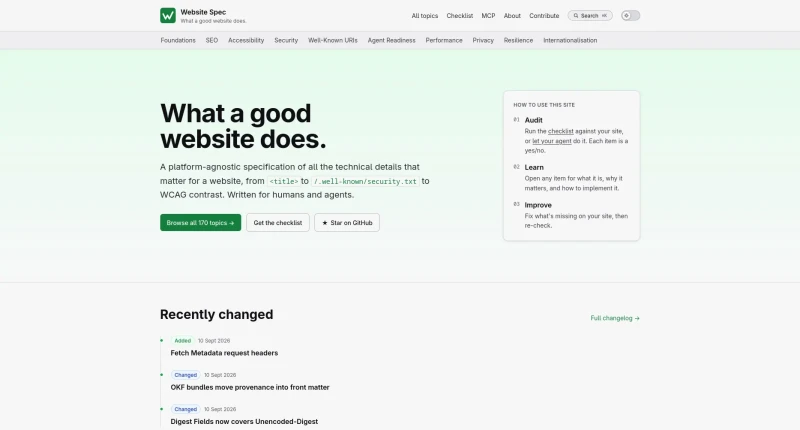
A platform-agnostic specification of all the technical details that matter for a website. Written for humans and agents.
The Website Specification is a platform-agnostic, open-source technical specification created by Joost de Valk and community contributors to define what makes a modern, high-quality website. Written for both human developers and AI agents, it aggregates official standards across the web into a practical 170-topic benchmark.
The main features and core areas of this specification include:
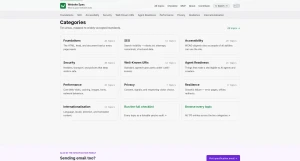
10 Standardized Technical Categories: Organizes 170 web topics across Foundations (20 topics), Accessibility (29 topics), Performance (26 topics), Agent Readiness (21 topics), Security (20 topics), SEO (14 topics), Internationalisation (13 topics), Well-Known URIs (12 topics), Resilience (8 topics), and Privacy (7 topics).
Standards-Based & Platform-Agnostic: Grounded strictly in official web standards (WHATWG, W3C, IETF RFCs, WCAG, MDN) rather than framework opinions, making it applicable to any tech stack—whether using WordPress, Next.js, Astro, Hugo, Django, Drupal, TYPO3, or plain HTML.
Built for Humans and AI Agents: Offers specialized interfaces for AI agents, including an open Model Context Protocol (MCP) server, a published Agent Skill, and per-page Markdown accessible via
/llms.txtorAccept: text/markdownrequest headers.Actionable Audit Workflow: Provides a simple three-step workflow—Audit (using a tickable yes/no checklist), Learn (understanding standard rationale and implementation), and Improve (re-testing after fixes).
Open-Source & Community-Driven: Licensed under Creative Commons (CC BY 4.0 for content) and MIT (for code), hosted transparently on GitHub with direct links to source standards and contribution options.
Ecosystem Expansion: Accompanied by sister projects like The Email Specification (
specification.email).
You may also be interested in ...

Svelte-Docs
webcomponents.org