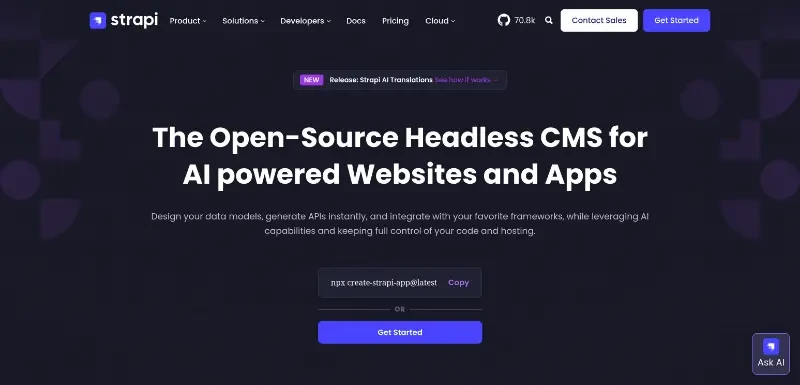


API creation made simple, secure and fast, Strapi is an open-source Content Management Framework (headless-CMS) to build powerful API with no effort.
Strapi is a leading open-source (MIT licensed) Headless CMS based on Node.js, designed to give developers the freedom to use their favorite tools while providing editors with an autonomous way to manage content.
The main features and functionalities of Strapi include:
API Design and Integration
Flexible API Creation: Users can design REST and GraphQL Content Delivery APIs to connect their content to any frontend.
Instant Generation: The platform allows developers to design data models and generate APIs instantly.
Backend Framework: It serves as a customizable framework to build, scale, and integrate backends with various developer tools.
Content Management and AI Capabilities
Autonomous Editing: Content managers can easily manage editing, publishing, and translations independently.
Strapi AI: A new feature that automates content modeling and translations, helping to streamline the creation of AI-powered websites and apps.
Structured Content: It provides business leaders with the benefits of structured content to manage brand narratives across multiple devices.
Customization and Collaboration
Personalization: The CMS can be personalized to meet unique project requirements.
Marketplace: The Strapi Market offers a variety of plugins and integrations to extend the platform's functionality.
Team Collaboration: It facilitates easy collaboration between team members on both code and content.
Deployment and Security
Flexible Hosting: Projects can be hosted on Strapi Cloud (a PaaS solution) or via a self-hosted Enterprise Edition.
Security Standards: Strapi implements robust security measures and is SOC 2 certified and GDPR compliant.
Global Community: As an open-source project, it encourages community contribution and collaboration via GitHub, Discord, and dedicated forums.
Strapi acts like a centralized "brain" for your digital content: instead of having your content trapped inside a single website, Strapi stores it in a flexible library that can send information through various "delivery pipes" (APIs) to reach any destination—whether it's a mobile app, an e-commerce site, or a smartwatch—all while using AI to help translate and organize that information automatically.

You may also be interested in ...

Vendure E-commerce

Grid gallery