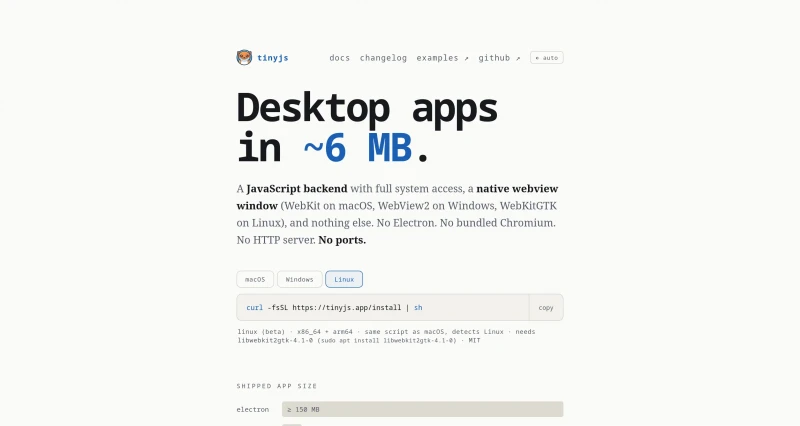
A JavaScript backend with full system access, a native webview window (WebKit on macOS, WebView2 on Windows, WebKitGTK on Linux), and nothing else. No Electron. No bundled Chromium. No HTTP server. No ports.
tinyjs is an open-source tool and runtime for building cross-platform desktop applications for macOS, Windows, and Linux in approximately 6 MB.
The main features of this framework include:
Ultra-Lightweight Footprint (~6 MB): While tools like Electron ship at \(\ge\)150 MB and Tauri at
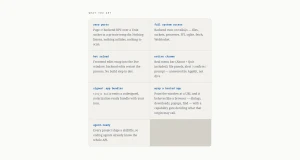
10 MB, tinyjs packages only a600 KB window process, the txiki.js backend runtime, and your plain application code by reusing the native webview engine already pre-installed on the host OS (WebKit on macOS, WebView2 on Windows, WebKitGTK on Linux).Pure JavaScript Backend (txiki.js): Runs its backend on txiki.js (QuickJS + libuv), granting full system access—including files, sockets, subprocesses, FFI, SQLite,
fetch, and WebSockets—entirely in JavaScript without needing a Rust compiler or build step.Zero-Port Security Architecture: Inter-Process Communication (IPC) between the webview window and the backend takes place over a private Unix socket (or named pipe on Windows) located in a private temporary directory, ensuring no ports are opened, scanned, or collided with.
Native System Controls: UI elements such as real desktop menu bars, file open/save panels, and alert/confirm/prompt dialogs are rendered directly by native OS frameworks (such as AppKit on macOS) rather than emulated HTML divs.
Flexible Tooling & Hot Reloading: Supports zero-dependency development with plain HTML/CSS/JS out of the box with instant hot reloading, or scaffolds React, Vue, Svelte, Solid, and TypeScript projects powered by Vite and esbuild.
Hosted Web App Wrapping: Can point its window at an existing web URL while maintaining a strict, per-origin capability gate in
tinyjs.jsonto control which native APIs that site is permitted to call.Bundling & Automatic Updates: Emits codesigned
.appbundles for macOS, portable folders for Windows, and Linux tarballs, featuring a built-in updater that validates SHA256 signatures, swaps binaries in place, and automatically rolls back on failure.Agent-Ready Ecosystem: Includes a built-in skill file in every project template so AI coding agents immediately understand the full API surface.

You may also be interested in ...

Wicked Blocks

Notyf