Open Source & Free Tools for Web Workers

Discover amazing tech resources, carefully handpicked to keep you up-to-date and elevate your efficiency. Already 1502 badass resources curated.

  • Remote Rocketship
    Sponsor

    Remote Rocketship

    Find Your Dream Remote Job. Search 100,000+ work from home jobs at top remote companies. Loved by 10,000+ remote workers

    Read more
  • Remote Rocketship
    Remote Rocketship Remote Rocketship Remote Rocketship Remote Rocketship

    Find Your Dream Remote Job. Search 100,000+ work from home jobs at top remote companies. Loved by 10,000+ remote workers

    Remote Rocketship is a powerful job search platform designed to help you land your dream remote career by uncovering thousands of opportunities that other job boards miss.

    Here are the key benefits that give you a competitive edge:

    • Access to "Hidden" Jobs: Unlike traditional job boards that require companies to pay for listings, Remote Rocketship scrapes the entire internet daily to find jobs directly from company websites. This ensures you don't miss out on positions from top companies that choose not to use paid platforms like LinkedIn.

    • A Crucial Head Start: In a competitive market, being first matters. The tool finds jobs as soon as they are posted, allowing you to submit your application before the competition even knows the role exists.

    • Effortless Job Hunting: Instead of manual searching, you can set up daily email alerts that deliver the latest openings tailored to your specific interests directly to your inbox.

    • Hyper-Targeted Search: You can filter through over 100,000 remote jobs using granular criteria such as minimum salary, tech stack (e.g., Python, AWS), visa sponsorship (H1B), or even "no degree required" roles.

    • Global and Diverse Opportunities: The platform covers a vast range of industries—including AI, Fintech, Cybersecurity, and Marketing—and tracks remote-friendly roles in the US, Canada, Europe, Brazil, and worldwide.

    • Authenticity and Trust: Built originally as a personal tool to help the founder's wife find work, the service focuses on providing legitimate, up-to-date work-from-home listings by checking company websites multiple times a day.

      The website link is an affiliate link.

  • Shipfast
    Sponsor

    Shipfast

    Ship your startup in days, not weeks. Shipfast is a NextJS boilerplate with all you need to build your SaaS, AI tool, or any other web app and make your first $ online fast.

    Read more
  • Shipfast
    Shipfast Shipfast Shipfast Shipfast Shipfast

    Ship your startup in days, not weeks. Shipfast is a NextJS boilerplate with all you need to build your SaaS, AI tool, or any other web app and make your first $ online fast.

    ShipFast is a comprehensive NextJS boilerplate designed to help entrepreneurs and developers launch startups as quickly as possible, ideally within minutes. It provides a pre-configured foundation that includes all the essential "plumbing" of a modern web application so users don't have to build common features from scratch.

    The main features of the tool include:

    • Full-Stack Infrastructure: It comes integrated with Next-Auth for user authentication (supporting Google OAuth and Magic Links) and offers out-of-the-box support for databases like MongoDB and Supabase.

    • Ready-to-Use UI Components: The boilerplate includes a wide array of React components specifically for conversion, such as pricing tables, FAQ sections, testimonials, and "Hero" sections.

    • Monetization & Communication: It features built-in integrations for Stripe subscriptions and payments, along with email handling systems for tools like Mailgun or Resend.

    • Optimized for Growth: The tool is pre-configured with SEO best practices, analytics, and customer support modules to help a new business scale.

    • Security & Reliability: It incorporates essential security features such as rate limiting, schema validation, and security headers to protect the application.

    • Centralized Customization: Most of the app's behavior is controlled through a single config.js file, which acts as the backbone of the application and simplifies the setup process.

    The project structure is designed for efficiency, with dedicated directories for API routes, database models, and library helper functions, allowing for a clean and scalable codebase.

  • Blog Quest
    December 17, 2025

    Blog Quest

    Blog Quest is a browser extension that helps you collect RSS and Atom feeds as you browse

    Read more
  • Blog Quest
    Blog Quest

    Blog Quest is a browser extension that helps you collect RSS and Atom feeds as you browse

    Blog Quest is a browser extension designed to help users automatically collect RSS and Atom feeds as they browse the web.

    Here is a summary of its main features and functionalities:

    Core Functionality and Operation

    • Automatic Feed Collection: Blog Quest quietly collects feed URLs by scanning pages for rel="alternate" links, which blogs use to reference their RSS feeds.

    • Passive Browsing: Users browse the web as usual, and the extension builds a collection of blogs in the background.

    • Calm Technology: The tool is designed not to compete for attention, allowing users to explore the collected feeds only when they are ready.

    • Pop-up View: Clicking the extension opens a pop-up window that displays the list of all collected feeds.

    • Availability: The extension is available for download on Chrome and Firefox.

    Integration and Export

    • OPML Export: It supports OPML export, allowing users to easily import all discovered feeds into many standard feed readers.

    • Custom Subscription: The "Subscribe Using" feature lets users choose how collected feeds are opened.

    • Reader Presets: It offers presets for quick integration with popular services like Feedly, FeedLand, and Inoreader.

    • Custom Template Support: Users can integrate custom feed readers by defining a subscription URL template where {feedUrl} is replaced by the actual RSS or Atom feed's URL.

    Privacy and Licensing

    • Strict Privacy: Blog Quest commits to privacy; nothing leaves the user's device.

    • No Analytics/Server: It runs entirely within the browser, never collects analytics, and does not require a server to operate.

    • Open Source: The project is open-source under the MIT license.

    GitHub Platform Features (Context)

    As the project is hosted on GitHub, it also leverages the platform's developer tools:

    • AI and Code Tools: Includes access to features like GitHub Copilot (to write code with AI), GitHub Spark (to build intelligent apps), and GitHub Models (to manage and compare prompts).

    • Developer Workflow: Supports standard workflows like Actions (to automate workflows), Codespaces (for instant dev environments), Issues (to plan and track work), and Code Review (to manage code changes).

    • Security: Offers GitHub Advanced Security features to find and fix vulnerabilities.

    • Search Functionality: Users can search code, repositories, users, issues, and pull requests, and use saved searches to filter results more quickly.

  • Sync-in
    December 15, 2025

    Sync-in

    Sync-in is your open-source platform to store, share, collaborate, and sync your files.

    Read more
  • Sync-in
    Sync-in Sync-in Sync-in

    Sync-in is your open-source platform to store, share, collaborate, and sync your files.

    Sync-in is an open-source platform for storing, sharing, collaborating on, and syncing files while maintaining full control over your data.

    Core Principles: Sync-in is built on open-source transparency, allowing you to host data on your own infrastructure for complete data sovereignty. It features security by design with granular permission systems, scalable architecture suitable for individual or enterprise use, and efficient performance with modern technology. You can access your files anywhere through browser, desktop client, or WebDAV.

    Major Features:

    The platform offers collaborative spaces where teams can work together with dedicated areas, autonomous creation, and fine-grained permissions based on roles. These spaces are naturally compartmentalized for security and regulatory compliance.

    Desktop synchronization applications for Windows, macOS, and Linux automatically sync files between your computer and Sync-in servers, with the ability to connect to multiple servers and manage sync direction, frequency, and detailed logs.

    Secure sharing capabilities allow both internal and external file sharing with granular permissions, secure links, access limits, expiration dates, and password protection for full control over document distribution.

    The guest system and personal groups enable collaboration with external partners while maintaining control over their access, with autonomous group creation organized by project, client, or team.

    Activity tracking provides real-time monitoring with in-file commenting, recent file views, and notification systems for effective collaboration.

    An advanced file manager offers drag-and-drop functionality, window management, smart clipboard, offline task manager, gallery view, sorting, filtering, and enhanced viewer capabilities.

    The smart search engine performs full-text searches across document content (not just filenames) supporting Microsoft Office, PDF, HTML, and plain text formats with keyword inclusion/exclusion.

    OnlyOffice integration enables real-time collaborative editing of documents, spreadsheets, and presentations with native Microsoft Office format support while respecting defined permissions.

    Finally, WebDAV integration allows you to mount spaces as network drives accessible from any device or application.

  • Uncloud
    December 12, 2025

    Uncloud

    Self-host and scale web apps without the complexity. Take your Docker Compose apps to production with zero-downtime deployments, automatic HTTPS, and cross-machine scaling. No Kubernetes required.

    Read more
  • Uncloud
    Uncloud Uncloud Uncloud Uncloud

    Self-host and scale web apps without the complexity. Take your Docker Compose apps to production with zero-downtime deployments, automatic HTTPS, and cross-machine scaling. No Kubernetes required.

    Uncloud is an open-source platform for self-hosting and scaling web applications without the complexity of Kubernetes. Here are its main features:

    Core Capabilities:

    • Docker Compose-based workflow - Deploy apps using familiar Docker Compose files

    • Zero-downtime deployments - Rolling deployments with no service interruption

    • Automatic HTTPS - Free TLS certificates via Let's Encrypt with built-in Caddy reverse proxy

    • Cross-machine scaling - Scale applications across multiple servers/VMs

    Architecture:

    • Fully decentralized - No central control plane to maintain; each machine holds a synchronized copy of cluster state

    • Secure private network - WireGuard mesh network with automatic peer discovery and NAT traversal

    • Service discovery - Built-in DNS that automatically tracks services across the network

    • Load balancing - Distributes traffic across container replicas on different machines

    Developer Experience:

    • Simple CLI - Docker-like commands to control your entire infrastructure

    • No image registry required - Build, push, and deploy with one command

    • Infrastructure as Code - Define your stack in Docker Compose format

    • Deploy anywhere - Works on cloud VMs, dedicated servers, bare metal, or on-premises

    Key Benefits:

    • Full control over infrastructure and data

    • Predictable costs without per-request pricing

    • No vendor lock-in

    • Mix different cloud providers and own hardware freely

    It's essentially a PaaS-like experience (similar to Heroku or Fly.io) but running on your own infrastructure.

  • Wafrn
    December 11, 2025

    Wafrn

    The Social network that respects you. Wafrn is a federated social media inspired by Tumblr that connects with both the Fediverse and Bluesky.

    Read more
  • Wafrn
    Wafrn Wafrn

    The Social network that respects you. Wafrn is a federated social media inspired by Tumblr that connects with both the Fediverse and Bluesky.

    Wafrn is an open-source, federated social media platform designed to be a Tumblr alternative that emphasizes user respect and customization,,.

    Here are the main features and functionalities of Wafrn:

    1. Interoperability and Federation

    • Dual Protocol Support: Wafrn connects simultaneously with both the Fediverse (using the ActivityPub protocol) and Bluesky (using the ATProtocol),.

    • Native Bluesky Integration: Unlike much of the Fediverse, Wafrn offers native Bluesky Integration,. This means that Bluesky users do not need to opt-in to a bridge to interact with Wafrn users.

    • Seamless Interaction: The native integration allows for the smooth flow of replies, likes, and boosts between Wafrn and Bluesky users,. Posts can be made visible on both Bluesky and Mastodon.

    • User and Data Portability: Users can keep all their data (posts, followers, likes, lists) when moving between ATProtocol-based sites (like Blacksky or Northsky),. If a user migrates from Bluesky to Wafrn, their posts, friends, and followers are preserved. This portability is cited as a way to escape "enshittification".

    2. User Experience and Customization

    • Theming and Custom CSS: Wafrn is highly focused on customization, allowing users to apply custom CSS to their profile, which then sets the default theme across their entire site view,. The default interface often resembles the Tumblr dashboard,.

    • Feeds: The platform offers three main feeds: the Dashboard (focused on followed accounts), Explore Wafrn (local Wafrn accounts), and Wafrn & Friends (combining local content with posts from other federated servers like Mastodon, Friendica, and Bluesky),.

    • Custom Feeds (Future): There is expressed interest in supporting Bluesky’s Custom Feeds for better discovery,.

    3. Posting, Content, and Format

    • Rich Formatting: Posts support a mix of Markdown (including CommonMark) and various HTML tags for formatting.

    • Inline Media: Users can embed media directly within the text of their posts using a specific markup (![media-{number}]).

    • Accessibility and Media: The platform takes accessibility seriously, requiring descriptions for images or videos (alt text). Posts are limited to displaying four pieces of media for Mastodon and Bluesky users.

    • "Tumblr-isms": Includes unique, playful features that capture a chaotic energy,:

      • Asks: A Question-and-Answer feature where any Fediverse account can submit questions, which appear in a special tab for the user to answer.

      • Bites: A "silly feature" resembling a poke that generates cute notifications,.

      • AI Filter: Allows users to transform the word “AI” to “cocaine” or another word using a custom filter,.

    4. Privacy, Security, and Ethos

    • Anti-AI Policy: Wafrn does not sell data for AI training, nor does it accept contributions involving AI generated artwork, code or text,,.

    • Post Privacy Options: Supports several levels of visibility: Public, Unlisted, This Instance Only, Followers-Only, and Direct Message (which is explicitly stated as not End-To-End-Encrypted).

    • Public Content Risk: The platform warns that public posts on Wafrn, especially those sent to Bluesky, cannot be prevented from being scraped by AI companies or others,.

    • Open Source Commitment: The code is public under the AGPLv3 (backend) and Apache License 2.0 (frontend),.

    5. Technical and Miscellaneous

    • Multi-Platform Access: Mobile apps are available for Android (via F-Droid, IzzyOnDroid) and Apple (App Store, Testflight).

    • Easter Egg: A "Super Secret Menu" contains an embedded WASM build of DosBox running a copy of Doom,.

  • Chi
    December 8, 2025

    Chi

    Lightweight, idiomatic and composable router for building Go HTTP services .

    Read more
  • Chi
    Chi

    Lightweight, idiomatic and composable router for building Go HTTP services .

    Chi (go-chi/chi/v5) is a lightweight, composable, and idiomatic Go HTTP router designed specifically for building REST API services,. It aims to provide strong routing features without the complexity or "bloat" found in full frameworks,.

    Here are the principal functionalities and features of Chi:

    1. Core Design and Philosophy

    • Lightweight and Idiomatic: Chi is characterized by its lightweight nature and its adherence to the standard net/http interfaces, making it highly idiomatic to the Go language,,.

    • Composability: It simplifies the construction of large REST API services by enabling the system to be broken down into smaller, manageable components.

    • Performance: Chi generally offers better performance than Gorilla Mux and consumes less memory. Compared to Gin, Chi typically uses fewer allocations while maintaining exceptional performance under high load.

    • Installation: It is installed as a dependency using the Go module system via the command go get -u github.com/go-chi/chi/v5,.

    2. Routing Capabilities

    • Standard HTTP Methods: Chi supports routing for all standard HTTP methods, including GET, POST, HEAD, PUT, PATCH, DELETE, OPTIONS, TRACE, and CONNECT.

    • Radix Tree Structure: The router is built on an efficient radix tree structure for quick and flexible routing,.

    • URL Parameter Handling: It simplifies the extraction of input parameters, whether they come from the URL, the request body, or query parameters. Specific parameters, such as a requested book ID, are easily read from the URL using the chi.URLParam function.

    • Sub-routers and Grouping: Chi allows for the creation of sub-routers using the r.Mount method, which helps organize and link related routes (e.g., all book routes linked to /books),,. Related routes can also be organized using r.Group.

    • Advanced Pattern Matching: It supports sophisticated URL pattern matching, including regex constraints (e.g., /{id:+}) and wildcard patterns (e.g., /files/{filename:.+}).

    3. Middleware System

    • Flexible and Focused Design: Chi's design places its middleware system at the forefront, allowing developers to easily compose and maintain their middleware stack with minimal boilerplate,.

    • Compatibility: Its middleware handlers are standard stdlib net/http handlers, ensuring compatibility with any middleware available in the Go community,.

    • Usage: Middleware defines pre-handler and post-handler stages for implementing cross-cutting concerns like authentication, logging, tracing, and general request processing,. Middleware can be applied globally (r.Use) or scoped to specific handlers or groups (r.Group or r.With).

    4. Context Management

    • Request-Scoped Data: Chi brilliantly leverages Go’s built-in context package to manage requests. Contexts act as carriers for important, request-scoped data, such as user IDs or request metadata, seamlessly passing information through the middleware chain to the handler,,.

    • Timeouts and Cancellation: Context is used for managing crucial elements like request timeouts to ensure the application remains responsive. Developers are advised to always call the cancel function when using contexts with timeouts or deadlines to prevent resource leaks.

    5. Testing and Error Handling

    • Simplified Error Handling: Error handling is simple, relying on the standard http package's Error() function to respond with a specific error message and HTTP status code constant (e.g., http.StatusNotFound),.

    • Unit Testing: Chi encourages unit testing by allowing the handler functions to use an interface for storage access (e.g., BookStorage), which makes it easy to substitute real storage with mock (fake) storage during tests,,. The httptest package can be used to construct the necessary http.ResponseWriter and http.Request parameters for isolated handler tests.

    • Integration Testing: Integration tests can be performed by starting a test server using the httptest.NewServer function, allowing tests to make actual HTTP requests against the defined router without mocking components,.

  • Glances
    December 10, 2025

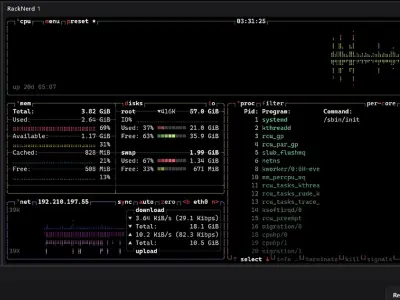
    Glances

    Glances is a cross-platform system monitoring tool written in Python.

    Read more
  • Glances
    Glances

    Glances is a cross-platform system monitoring tool written in Python.

    Glances is a cross-platform system monitoring tool written in Python.

    Here is a summary of its main features and functionalities:

    I. Core Monitoring Capabilities

    Glances is designed to provide "An Eye on your system" and tracks a comprehensive list of system metrics:

    • System Resources: Monitors CPU, Memory, and system Load.

    • Process Information: Provides a detailed Process list.

    • Storage and Networking: Tracks Disk I/O (Input/Output), Network interface activity, and Filesystem usage (including specific folders).

    • Hardware and Status: Reports on IRQ / Raid status, Sensors, System info, and Uptime.

    • Containers: Supports monitoring of Docker and Podman containers.

    • Advanced Features: Includes basic Monitor and Alert capabilities.

    • Quicklook: Offers a simplified view showing CPU, MEM, and LOAD.

    II. Platform and Installation

    • Cross-platform Compatibility: Written in Python, Glances runs on almost any platform, including GNU/Linux, FreeBSD, OS X, and Windows.

    • Installation: It is available on PyPI (Python Package Index).

      • A minimal version can be installed using $ pip install --user glances.

      • A full installation, including all plugins, is done via $ pip install --user glances[all].

    III. Data Access and Integration (API and Export)

    Glances provides several ways to access and utilize the monitored data outside of the command-line interface:

    • Web User Interface (Web UI): It features a built-in Web UI allowing users to monitor their system from any device when a terminal is not available.

    • API: It includes both an XML-RPC server and a RESTful JSON API, which can be used by other client software.

    • Data Export: System statistics can be exported to multiple backends, including CSV, InfluxDB, Cassandra, OpenTSDB, StatsD, ElasticSearch, or even RabbitMQ.

    • Grafana Integration: Glances also provides a dedicated Grafana dashboard.

  • Pacsea
    December 8, 2025

    Pacsea

    Fast TUI for searching, inspecting, and queueing pacman/AUR packages.

    Read more
  • Pacsea
    Pacsea

    Fast TUI for searching, inspecting, and queueing pacman/AUR packages.

    Pacsea is a fast, keyboard-first Terminal User Interface (TUI) designed for searching, inspecting, queueing, and managing packages on Arch Linux and AUR (Arch User Repository) systems.

    Here is a summary of its main features and functionalities:

    Core Functionality and Interface

    TUI Design: Pacsea provides a fast, friendly TUI built specifically for speed and minimal keystrokes.

    Keyboard-First Navigation: It features a keyboard-first interface with Vim-friendly navigation.

    Integrated Process Execution: All operations, including installations and removals, execute directly within the TUI with real-time output streaming, progress bars, and inline password prompts, eliminating the need for external terminals.

    Command Line Interface (CLI): Pacsea supports powerful command-line operations that allow users to manage packages without launching the TUI.

    Search, Discovery, and Installation

    Unified Search: Provides fast results across official repos and the AUR.

    Fuzzy Search: Includes a toggle for a flexible fuzzy search mode to locate packages without exact names.

    Queueing: Users can add packages to a queue and confirm installs later.

    Persistent Lists: Saves recent searches and the install list.

    Preflight Review: A Preflight review modal appears before installs/removals, allowing users to inspect dependencies, files, and configuration conflicts. For removals, it reviews reverse dependencies and affected services.

    Distro-Aware Updates: Includes automatic detection and use of appropriate mirror tools for Manjaro, EndeavourOS, CachyOS, Artix, and standard Arch distributions.

    Package Inspection and Management

    Always-Visible Details: Package details are always visible, and users can open package links with a click.

    PKGBUILD Preview: Offers a PKGBUILD preview viewer that allows copying the PKGBUILD content with one click.

    AUR Comment Viewer: Allows users to view community comments for AUR packages directly in Pacsea with markdown support, clickable URLs, and automatic updates.

    Status Markings: Provides visual indicators for out-of-date [OOD] and orphaned [ORPHAN] packages.

    Installed-only Mode: A specific mode to review and remove installed packages safely, configurable to show only leaf packages or all explicitly installed packages.

    Downgrade Capability: Allows users to downgrade installed packages to previous versions using the downgrade tool.

    Security Features (Security-First AUR Workflow)

    Pacsea implements a crucial security-first approach for installing AUR Packages:

    Integrated Security Scanning: Users can run comprehensive scans before building AUR packages.

    Multiple Scan Tools: Scans utilize various tools, including ClamAV (antivirus), Trivy (filesystem), Semgrep (static analysis), ShellCheck (for PKGBUILD/.install files), VirusTotal hash lookups, custom suspicious pattern scanning, and aur-sleuth (LLM audit).

    Scan Summary: Scans generate a comprehensive summary detailing infections, vulnerabilities by severity, and statistics.

    VirusTotal Integration:** Allows users to **configure their VirusTotal API key** directly from a modal to enable hash lookups.

    Customization and System Tools

    High Configurability: Pacsea is highly configurable, utilizing three configuration files in ~/.config/pacsea/: settings.conf (app behavior), theme.conf (colors/styling), and keybinds.conf (keyboard shortcuts).

    Optional Helper Tool Installation: A dedicated modal allows users to install and verify recommended helper tools (like AUR helpers, editors, terminal emulators, and security utilities).

    System Update Dialog: Includes a system update dialog** with options like Force Sync mode (-Syyu).

  • CapRover
    December 5, 2025

    CapRover

    CapRover is an extremely easy to use app/database deployment & web server manager for your NodeJS, Python, PHP, ASP.NET, Ruby, MySQL, MongoDB, Postgres, WordPress (and etc...) applications!

    Read more
  • CapRover
    CapRover CapRover CapRover

    CapRover is an extremely easy to use app/database deployment & web server manager for your NodeJS, Python, PHP, ASP.NET, Ruby, MySQL, MongoDB, Postgres, WordPress (and etc...) applications!

    CapRover is a free, self-hosted Platform as a Service (PaaS) designed to simplify the deployment and management of applications and databases.

    Here is a summary of CapRover's main features and functionalities:

    I. Core Purpose and Technology Stack

    • Self-hosted PaaS: CapRover is a Scalable, Free and Self-hosted PaaS. It aims to reduce the cost of deployment, offering the same server capacity that might cost $50/month on services like Heroku or Microsoft Azure for as little as $6/month on a service like DigitalOcean.

    • "It Just Works" Deployment: The platform is designed to make app/database deployment and web server management extremely easy to use. It allows developers to go from http://localhost:3000 to https://www.awesome.com in seconds.

    • Underlying Technologies: CapRover is robust and fast because it utilizes several established technologies: Docker Swarm for containerization and clustering, nginx for load-balancing, and Let's Encrypt for free SSL (HTTPS). It also uses NetData.

    II. Application and Language Support

    • Any Language Deployment: CapRover supports deploying applications written in virtually any language. This includes popular environments such as NodeJS, Python, PHP, ASP.NET, Ruby, and Java.

    • One-Click Applications: It simplifies the deployment of databases and applications through One-Click Apps. Deploying these apps is a matter of seconds. Supported examples include MySQL, MongoDB, Postgres, WordPress, and Parse.

    III. Interface and Workflow

    • Dual Interfaces: CapCaptain provides both a Web GUI for ease of access and convenience, and a CLI (Command Line Interface) for automation and scripting.

    • Easy Deployment Methods: Developers have multiple ways to deploy their code:

      • Uploading the source directly from the dashboard.

      • Using the command line with caprover deploy.

      • Utilizing webhooks to build upon git push.

    • Simplified Docker Operations: The Simple Interface handles many underlying Docker operations, such as exposing container ports to the host, setting up persistent directories, and managing the instance count.

    IV. Security, Customization, and Scalability

    • Free SSL (HTTPS): CapCaptain integrates Let's Encrypt to secure services over HTTPS for FREE. It also offers the ability to automatically redirect HTTP to HTTPS.

    • Full Customization: While CapCaptain handles basic operations automatically, it caters to advanced users by allowing them to customize any specific settings. This includes optionally customizing the nginx config to enable HTTP2, specific caching logic, and custom SSL certs.

    • No Vendor Lock-in: A critical feature is No lock-in! Users can remove CapCaptain and their deployed applications will keep working.

    • Cluster Ready: Users can attach more nodes and create a cluster in seconds. CapCaptain automatically configures nginx for load balancing across the cluster.

    CapRover's primary benefit is allowing developers to increase productivity by focusing on their apps rather than the tedious setup, configurations, and server maintenance.

  • rssrssrssrss
    December 4, 2025

    rssrssrssrss

    Combine multiple RSS feeds into one unified feed

    Read more
  • rssrssrssrss
    rssrssrssrss

    Combine multiple RSS feeds into one unified feed

    rssrssrssrss is designed to combine multiple RSS feeds into one unified feed.

    Here is a summary of its main features and functionalities:

    Core Functionality

    • Feed Merging: The primary function is to combine multiple RSS feeds into one unified feed.

    • Interleaving Content: This simple tool specifically addresses the need to interleave multiple RSS feeds, which the sources note "relatively few things do a great job of".

    Input and Editing

    • Adding Feeds: Users can add RSS feeds by entering one RSS feed URL per line in the provided input box.

    • Editing Existing Feeds: Users can also paste an existing merged feed URL to edit it.

    Output and Security

    • Permalink Generation: Once the feeds are added and reviewed, the user can generate a permalink.

    • Encoding: This permalink is a base-64 encoded URL of the feeds. The source mentions this encoding helps ensure "no real worry about bitrot".

    User Experience and Technical Details

    • Preview: The service provides a preview of the merged feed so users can ensure the output is what they want.

    • Open Source: The tool is open source.

    • Creator: It was built by Buttondown.

    • Alternative Name: Users may also refer to it as "rss4".

  • Self.so
    December 3, 2025

    Self.so

    Turn your resume/LinkedIn into a professional website.

    Read more
  • Self.so
    Self.so

    Turn your resume/LinkedIn into a professional website.

    Self.so - Resume to Website is an application focused on rapidly creating professional online presence.

    Here is a summary of its main features and functionalities:

    • Core Functionality: Self.so is designed to turn your resume or LinkedIn profile into a professional website.

    • Rapid Conversion: The conversion process is designed to be extremely fast. It can create a LinkedIn website in one click, and uploading a standard resume to initiate the process takes 1 minute.

    • Accessibility and Licensing: The service is 100% free and open source.

  • P2Panda
    December 2, 2025

    P2Panda

    Building blocks for peer-to-peer applications.

    Read more
  • P2Panda
    P2Panda

    Building blocks for peer-to-peer applications.

    p2panda offers building blocks for peer-to-peer applications. Its primary aim is to provide everything necessary to create modern, privacy-respecting and secure local-first applications.

    Here is a summary of p2panda's main features and functionalities:

    Core Architecture and Design Philosophy

    • Modular Approach: p2panda adopts a modular approach using various Rust crates, allowing projects the freedom to select specific components they need and integrate them with minimal friction. This design contributes to a wider, interoperable p2p ecosystem.

    • Data Compatibility: Many Rust crates operate over raw bytes and are fully compatible with your own data types and any CRDT (Conflict-free Replicated Data Type).

    • Offline-First Guarantee: The project is founded on a radical offline-first guarantee. Collaboration, encryption, and access-control must function even when operating over unstable or ephemeral connections.

    • Post-Internet Communication: The protocol is "broadcast-only" at its heart, making the data compatible with post-internet communication infrastructure such as shortwave, packet radio, Bluetooth Low Energy (BLE), LoRa, or even a USB stick.

    • Standard Integration: p2panda utilizes existing libraries and well-established standards like iroh, BLAKE3, Ed25519, STUN, CBOR, TLS, QUIC, and Double Ratchet.

    Specific Library Features (Crates)

    p2panda provides several specialized libraries for building P2P applications:

    Library NameFunctionalityp2panda-netFinds peers, connects to them directly, and exchanges data in byte streams.p2panda-discoveryProvides solutions to find other peers in the local network or on the internet.p2panda-syncImplements protocols to efficiently "catch up on past state" with other peers.p2panda-blobsEnables efficient sending, receiving, and storage of (very large) files.p2panda-coreManages the highly extensible data-types required for the secure, distributed, and efficient exchange of data.p2panda-storeOffers interfaces to store p2panda data types in databases, memory, or file-systems.p2panda-streamProvides methods to process p2panda data streams before they reach the application.p2panda-encryptionSupports decentralized secure data- and message encryption for groups, featuring post-compromise security and optional forward secrecy.p2panda-authFacilitates decentralised group management with fine-grained, per-member permissions.p2panda-node (WIP)Acts as an all-in-one p2panda node usable in federated or fully decentralised networks, supporting "lightweight" clients running in the browser.

    Collaborative Projects and Research

    p2panda is also a multifaceted project involved in organizing community events, research, and application development. Related application projects demonstrate the capabilities of the tool:

    • Reflection (coming mid-2025): A local-first, collaborative text editor.

    • Toolkitty (coming mid-2025): An autonomous coordination toolkit for collectives, built for iOS, Android, and Desktop.

    • Meli Bees App: A collaborative Android app for sighting and categorization of bee species.

    • rhio: A peer-to-peer message router and file sync solution that allows processes to rapidly exchange messages and efficiently replicate large files without central coordination.

    Analogy: p2panda acts like an advanced LEGO set for building secure, digital neighborhoods. Instead of relying on a central city infrastructure (the internet backbone), each block (crate) lets you build essential features—like finding neighbors (p2panda-discovery), securely whispering secrets (p2panda-encryption), or trading large goods (p2panda-blobs)—all while ensuring your neighborhood can still function perfectly even if the main power lines go down (radical offline-first guarantee).

  • Veryicon
    December 1, 2025

    Veryicon

    Search and free download over 500,000 high quality ICO, PNG Icons.

    Read more
  • Veryicon
    Veryicon Veryicon

    Search and free download over 500,000 high quality ICO, PNG Icons.

    The VeryIcom.com is a icon search engine, it contents over 20000 high quaility web icons in more than 1000 icon packs. Each Icon has serval file formats such as PNG, ICO, you can free browse and download for Windows, Macintosh and Linux Systems.

    All the icons can be free used for non-commercial, but part of them copyright belongs original author, if you want to use icons for commercial purposes, you have to pay for obtain the author's License agreement.

    If you are an icon designer and you want to share your artworks to others, please send a mail to master@veryicon.com or submit you artworks on http://www.veryicon.com/submit.php. High quality Free Icons artist is welcome.

  • Woodpecker
    November 28, 2025

    Woodpecker

    Woodpecker is a simple, yet powerful CI/CD engine with great extensibility.

    Read more
  • Woodpecker
    Woodpecker

    Woodpecker is a simple, yet powerful CI/CD engine with great extensibility.

    Woodpecker CI is characterized as a simple, yet powerful CI/CD engine with great extensibility.

    Here are the principal functionalities and features of Woodpecker CI:

    Core Functionality and Technology

    • CI/CD Engine: Woodpecker serves as a Continuous Integration/Continuous Delivery engine.

    • Docker Container Based: It utilizes docker containers to execute pipeline steps.

    • Extensibility: It possesses great extensibility. Users can create plugins to extend the pipeline features, particularly when needing functionality beyond a standard Docker image.

    • Multi Workflows: Woodpecker allows users to easily create multiple workflows for their project, and these workflows can even depend on each other.

    Accessibility and Licensing

    • Open Source and Free: Woodpecker is OpenSource and free.

    • Availability: It is and always will be totally free.

    • Contribution: Since the source code is open-source, users are encouraged to contribute to help evolving the project.

  • Silex
    November 27, 2025

    Silex

    A free and open solution, developed by those who use it. Silex is a professional site builder, with no subscriptions and no limitations.

    Read more
  • Silex
    Silex Silex Silex

    A free and open solution, developed by those who use it. Silex is a professional site builder, with no subscriptions and no limitations.

    Silex, is a Free Website Builder that is characterized as Libre Software and an Open-Source No-Code platform. S It is often referred to as a promising open-source alternative to tools like Webflow.

    Here are the principal functionalities and features of Silex:

    1. Core Philosophy and Architecture

    • Free and Open Source (Libre Software): Silex is 100% free and open source. It was born free and open-source in 2009. All features are free of charge.

    • Non-Profit Backing: Silex is backed and maintained by the non-profit organization Silex Labs, based in Paris, France, which holds the copyright. This commitment prioritizes supporting the commons.

    • Licensing: Silex is licensed under AGPL and maintains this license without a Contributor License Agreement (CLA), ensuring the price remains free for everyone without restrictions on software usage.

    • Respect and Privacy: Silex emphasizes respect. The websites created using Silex include no tracking nor third-party cookies. The official Silex instance runs on eco-friendly servers controlled by the organization, and user data is not for sale.

    • Hosting: Silex offers free hosting. Its official instance is hosted in Europe.

    2. Website Creation and Features

    • No-Code Designer: Silex provides a No-Code Designer platform for creating websites without coding. It is described as the best "no code" website builder out there.

    • Output: It generates fast secure static websites.

    • Flexibility and Standards: Silex exposes HTML and CSS concepts, ensuring that what users learn is universally applicable and future-proof, avoiding vendor lock-in. It is built on web and open standards.

    • Design Workflow: The workflow uses drag and drop functionality to add components, making it easy to iterate over design.

    • Optimization: Websites powered by Silex are fast to load, optimized for SEO, mobile friendly, and accessible.

    • Customization (Ultimate Flexibility): Its open architecture and source code mean unparalleled customization, including choices for hosting and CMS integration.

    3. Integration and Headless Web

    • Headless and Composable Web: Silex is designed as the next-generation builder for the headless, composable, and static web.

    • CMS Integration: Silex supports CMS Integration. Users can start with a simple static site and then plug in any CMS to incorporate dynamic data.

    • Supported CMS/APIs: It integrates with WordPress, Strapi, Squidex, or a user's own API. This allows clients to edit content while keeping the visual editing simple.

    4. Community and Contribution

    • Community Focus: Silex is driven By Users For Users. The community includes like-minded developers, no-code developers, web designers, hobbyists, and professionals.

    • Contribution: User contributions directly fuel Silex enhancements and community growth. Users can choose which features they work on or fund. The system relies on its users for its future.

    • Engagement: The community engages through Forums, Chat, Meetups, and a Newsletter.

    • Learning and Resources: Silex offers resources for users to Learn and Grow, including videos, documentation (Wiki), and regular demos/meetups.

    5. Monetization and Independence

    • User Monetization: Users are the only ones who can monetize their work and their website visitors.

    • Independence: Silex offers users control over their tools, costs, and the websites they produce.

    • Commercial Partner: While the core product is free, a partner, Elest.io, offers paid hosted Silex for agencies.

  • Exportify
    November 26, 2025

    Exportify

    A tool to let you export your Spotify playlists.

    Read more
  • Exportify
    Exportify

    A tool to let you export your Spotify playlists.

    Exportify is an open-source web application designed to Export/Backup Spotify playlists using the Web API. It addresses the lack of a native export/archive/backup function within the standard Spotify client.

    Here are the principal functionalities and features of Exportify:

    Core Functionality and Architecture

    • Purpose: Exportify provides a simple interface for exporting Spotify playlists.

    • Privacy and Data: No data will be saved; the entire application runs in the browser.

    • Access: It requires users to grant read-only access to their Spotify playlists.

    • Output Format: Playlists are exported in UTF-8 encoded CSV format.

    • Mass Export: Users can click 'Export All' to save a zip file containing a CSV file for each playlist in their account.

    • Rate Limiting: It includes advanced rate limiting handling for speedy exports.

    • Compatibility: The application is Mobile friendly.

    • Licensing: Exportify is released under the MIT license.

    Export Data and Customization

    The exported track data includes standard fields from the Spotify track object such as Track URI, Track Name, Artist URI(s), Artist Name(s), Album Name, Album Release Date, Track Duration (ms), Popularity, ISRC, Added By, and Added At.

    Users can optionally include additional data by clicking the settings cog:

    • Artist Data: Adds Artist Genres.

    • Audio Features Data: Adds analytical data such as Danceability, Energy, Tempo, Loudness, Key, and Valence.

    • Album Data: Adds fields from the full Spotify album object, including Album Genres, Label, and Copyrights. (Note: Exporting more data will increase the time taken for the export).

    Playlist Management and Usage

    • Re-Importing: Users can re-import saved playlists by opening the CSV file, copying the spotify:track:xxx URIs, creating a new playlist in Spotify (tested with the desktop app), and pasting the URIs.

    • Search Facility: A search facility allows users to quickly find specific playlists by name.

      • Searching is case-insensitive.

      • Advanced Search Syntax is supported, allowing filtering by status (e.g., public:true, collaborative:false) or owner (owner:me, owner:[owner]).

      • Search results can be exported as a zip file by clicking "Export Results".

    Interface and Development

    • Localization: Exportify is available in 10 languages.

    • Display: It features a Dark mode.

    • Technology Stack: The application is built using a Modern React-based development stack. The primary language is TypeScript (96.1%). It utilizes tools like Bootstrap 5, Font Awesome 6, and react-i18next.

    • Deployment: The application can be built and run using Docker.

    • Caveat: The tool is limited by the Spotify Web API, which currently does not return folders.

    • Disclaimer: The project is not affiliated with Spotify.

  • Supahero
    November 25, 2025

    Supahero

    Curated collection of beautiful website hero sections.

    Read more
  • Supahero
    Supahero Supahero Supahero

    Curated collection of beautiful website hero sections.

    Supahero is a Website hero section library. Its core purpose is to provide a curated collection of beautiful website hero sections, serving as a handpicked library of stunning hero designs intended to captivate and engage users, perfect for elevating your next web project.

    Here are the principal functionalities and features:

    Core Content and Organization

    • Content Offering: Supahero provides a comprehensive library of reusable website hero sections.

    • Quality and Goal: The sections are described as beautiful and inspiring, high-quality hero designs for every niche and style.

    • Content Tiers: The collection includes standard listings and specific Premium hero sections.

    • Categorization: The hero sections are organized and searchable by various styles, including: All, Dark, Minimal, Bento, 3D, Colorful, Light, Video, Pastel, Illustration, Typo, Image, and Gradient.

    Platform and Related Resources

    • Navigation and Discovery: The platform offers sections dedicated to Websites, Jobs, Tools, Templates, Pricing, and Subscribe.

    • Ecosystem Components: Supahero features resources aimed at web designers and developers, including:

      • Smart Framer Components.

      • Framer UI kit.

      • Icon Library.

      • Notion Templates.

      • A Mockup Generator.

    • Featured and Sponsored Tools: The site prominently features and is sponsored by several related design and development tools, such as:

      • Frameblox (Ultimate UI kit, design system, templates for Framer).

      • Framer Configurator (to sell on Framer without third-party tools).

      • Mocku.co (The Fastest Way to Generate Mockups, including AI Mockup Generator and Video Mockups).

    User Interaction

    • Newsletter Subscription: The site offers users the ability to Subscribe to its newsletter ("just the good stuff, no spam").

    • Submission: Users have options to Submit content or Submit Job listings.

    • Affiliate Disclaimer: The site explicitly mentions that it includes affiliate links.